

Milk Or Is It? | Oatly Appeal Dismissed
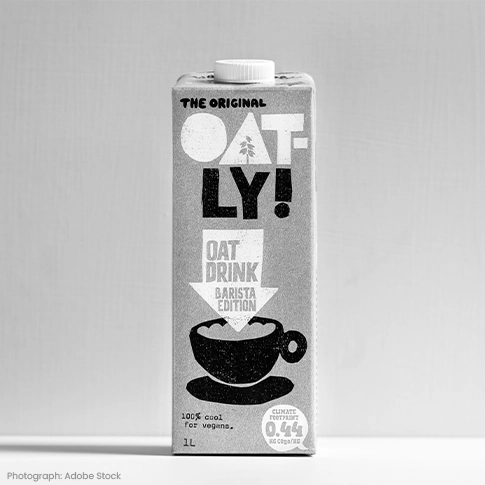

The UK Supreme Court put a distinct ‘marker’ down as to how food and drink designations in a ‘post-Brexit’ UK are adhere to.
Products of a Designated Origin (‘PDO‘) is not new. Manx Lamb can only be called Manx Lamb if it comes from the Isle of Man. Champagne is only permitted to be called Champagne if it comes from the appropriate region of France. Cornish Pasties are only able to be called Cornish Pasties if they come from Cornwall. These PDOs all help protect the key products originating from those areas.
These PDOs are designated and accounted for by legislation. Simply put, you cannot call something one thing simply because you want to. Anything not produced in the Champagne region cannot be described as Champagne but an alternative like ’sparkling wine.‘ Lamb from the Isle of Man can only be described as 'Manx lamb' not ’Welsh lamb‘ or ‘New Zealand lamb.’ So, should products that are not traditionally milk (or milk based) be able to call themselves milk?
The reality, following the handing down of the Supreme Court’s decision in Dairy UK Ltd v Oatly AB [2026] UKSC 4 that the answer is ‘no’.
On handing down its Judgment, the Supreme Court has determined that the use by Oatly of ‘post milk generation’ was a breach of the 2013 Parliament and Council Regulation (EU) No 1308/2013 (Annex VII Part III), because the product being sold was not milk, in that it was not a secretion from a bovine animal. Even in circumstances where milk comes from an animal, if it is not a bovine animal, then the milk must be clearly labelled as not from a cow. The Supreme Court held that designations of ‘milk’ and ‘milk products’ can only be utilised on products that are referenced on the Annex to the aforesaid Regulation.
The ruling is important for several reasons
First, it showed that the UKIPOs initial determination of the interpretation of the trade mark and its purpose was correct, in that it was right to have rejected, at first instance, the registration given the strict application of 2013 Parliament and Council Regulation (EU) No 1308/2013.
Additonally, it shows the significance of ensuring that trade marks, ‘straplines’ and slogans adhere to the law, while also properly identifying the characteristics for the Mark. Before the Supreme Court. Oatly argued that the phrase ‘post milk generation’ was a characteristic quality of the product. The Court of Appeal and ultimately, the Supreme Court Judges disagreed. Their view was that Oatly’s use of the phrase was far from aligned with describing the characteristics of a product but was instead intending to appeal to a specific target market, namely those who did not drink ‘traditional’ milk, whether through choice or medical reasoning.
Crucially, and perhaps the most significant for many IP Rights holders is that, notwithstanding Brexit, the UK Courts continue to have a significant alignment with the European regime on specifically designated dairy products such as ‘plant-based’ cheese, yoghurt and ice cream.
This ruling may therefore have implications for retailers and SMEs alike, because it is clear that the Court will uphold alignment with the EU on matters related to products that are traditionally associated with dairy. Unless there is going to be significant re-branding undertaken, retailers and manufacturers of ‘alternatives’ may find themselves facing some form of infringement, invalidation or cancellation proceedings by entities such as Dairy UK Limited, who represent UK farmers.
Given the Supreme Court’s findings, it means that Oatly’s trade mark was invalidly registered for certain products.
Procedural History
Following Oatly’s submission for trade mark protection in Classes 29, 30 and 32, as filed at the UKIPO, Diary UK Limited intervened and sought to oppose the application. Following a hearing, the UKIP determined that the application should fail, apart from in respect of T-shirts, which had also been applied for under s3(4) of the Trade Marks Act 1994, because the Mark contained the word ‘milk’ and the classes in which protection had been sought (29,30 and 32) were not milk.
As it was entitled to do, Oatly appealed to the High Court. The High Court found in favour of Oatly and reversed the UKIPOs decision, because it considered that the Hearing Office in the UKIPO construed the prohibition of designation too broadly. Specifically, that it was not the use of the word ‘milk’ that was restricted from a marketing perspective, but rather the inference that the product was milk when in fact it was not.
Richard Smith J stated “it is the use of the term ‘milk’ for products to identify them as being milk, not merely its use in their marketing, that constitutes their designation as such. In this case, the Mark was registered for a variety of goods in different classes and, although it may well have been used in their marketing, it does not purport to market them as any particular product, let alone as milk. Since the Mark does not designate those goods as ‘milk,’ point 5 is not engaged and no question of the proviso to point 5 arises.”
Dairy UK Limited asserted that the High Court had erred in its application of the law, particularly in light of the strict parameters of 2013 Parliament and Council Regulation (EU) No 1308/2013, and sought leave to appeal to the Court of Appeal.
Permission to appeal to the Court of Appeal was granted.
The Court of Appeal heard the arguments and considered that the High Court had misinterpreted the relevant law. It therefore reversed the decision, thereby making the UKIPOs first instance decision stand. The Court’s determination was that ‘milk’ is a protected designation that cannot be used for purely plant-based products, irrespective of whether it is a part of a larger trade mark, and that ‘Post Milk Generation’ did not meet the criteria for legal exception.
Mr Lord Justice Arnold, whilst sitting in the Court of Appeal stated “I agree with the hearing officer that it would be understood as referring to potential consumers of the goods. It may be understood as alluding to the fact that the goods are non-dairy products, but it does not clearly describe any such characteristic.”
In agreement, Mr Lord Justice Snowden stated “…I entirely agree with the critical point made by Lord Justice Arnold at para 56 above, that if Oatly was entitled to argue that the Trade Mark fell within the second limb of the exception in Point 5, its argument would nevertheless fail on the facts. That is because the Trade Mark ‘POST MILK GENERATION’ does not describe, clearly or at all, a characteristic quality of any of the products in classes 29, 30 and 32 in relation to which Oatly wishes to use it. Rather, as obviously implied by the use of the words ‘post’ and ‘generation,’ the Trade Mark describes the age-related characteristic of a particular cohort of people which Oatly intends should buy or consume its products."
Oatly disagreed with the Court of Appeal and sought leave to appeal to the Supreme Court.
Key elements considered
The Supreme Court looked at the following legal issues:
- Whether a trade mark constitutes a ‘designation’ under the regulations,
- whether the inclusion of additional words provide some form of ‘acceptance’ for use on non-traditional products (i.e. plant based milk); and
- whether the Mark fell qualified for an exemption for products where a name describes a characteristic quality or is established ‘traditional usage.’
In summation, the Supreme Court found that ‘traditional’ dairy-based products, where milk is a component of the Mark, can only be a product that is derived from a normal mammary secretion of a bovine animal. The inclusion of additional wordings does not provide an exemption i.e. you cannot say something is “milk” when it is not, and it dismissed the appeal on that basis.
It is suspected that manufacturers such as Oatly will now revise their IP portfolios and strategies in order to describe products that wants to be something else but now cannot be characterised as such.
How Can We Assist?
Any dispute involving intellectual property requires a clear and comprehensive understanding of this complex area of law. Before any court proceedings are commenced, it is essential that your position is fully assessed and that all relevant options are explored with an experienced intellectual property lawyer.
Our intellectual property lawyers advise on trade marks, IP infringement, and IP‑related disputes. We provide clear legal guidance, alternative dispute resolution, and comprehensive protection strategies tailored to your specific requirements.
Tel: 0333 370 4333
Email: info@kangssolicitors.co.uk
We provide initial no obligation discussion at our three offices in London, Birmingham, and Manchester. Alternatively, discussions can be held through video conferencing or telephone.





Top ranked by leading legal directories Chambers UK and the Legal 500.