


Offensive Weapons in a Private Place & Your Home
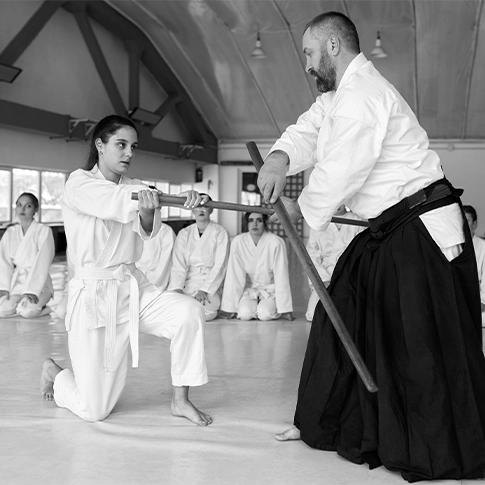

Many individuals keep swords or other weapons at home for legitimate purposes, such as hobbies involving historical re-enactment or for use by martial arts practitioners in teaching and demonstrations. The Offensive Weapons Act 2019 and the Prevention of Crime Act 1953 are designed to address crimes involving offensive weapons and not intended to target hobbyists or interfere with lawful employment. However, weapons kept for these purposes may still fall within the legal definition of an offensive weapon, and by keeping them at home, you could be committing an offence.
Two of the most frequently asked questions are:
- Is it illegal to possess an offensive weapon in your home or in a private place?
- What is classed as an offensive weapon?
According to the law, any person found in possession of specified weapons in a private place is committing an offence. While there are recognised legal defences for such possession, the matter is complex.
Mohammed Ahmed of KANGS answers the frequently asked questions and comments generally upon the current law and the Government’s proposals concerning offensive weapons.
Contents
Governments Efforts to Prevent Knife Crime
Knife crime is a crime involving an object with a blade or sharp instrument. Whilst recent data suggests a slight decline, the extent of knife-related offences continues to pose difficult challenges for both law enforcement and policy makers, as highlighted by the Huntingdon train attack.
As the result of a significant escalation in knife crime during the period from 2019 to 2020, a comprehensive review led to the introduction of section 46 of the Offensive Weapons Act 2019, which amended section 141 of the Criminal Justice Act 1988, and came into effect on 14th July 2021.
Additionally, the Government is pursuing its ‘Safer Streets Mission’ with the intent to halve knife crime within a decade. The new Crime and Policing Bill seeks to strengthen the law on the online sale of knives and provide the Police and the Courts with the necessary powers to remove offensive weapons off the streets.
The Relevant Law
To answer the questions of what is classed as an offensive weapon, the Prevention of Crime Act 1953 defines an offensive weapon as:
‘any article made or adapted for use for causing injury to the person, or intended by the person having it with him for such use by him or by some other person.’
The law surrounding offensive weapons is complex and is entwined with other legislation detailed below.
The Criminal Justice Act 1988
s. 141 Offensive weapons
Any person who manufactures, sells or hires or offers for sale or hire, exposes or has in his possession for the purpose of sale or hire, or lends or gives to any other person, a weapon to which this section applies shall be guilty of an offence.
The Criminal Justice Act 1988 (Offensive Weapons Order) 1988
This Order schedules an extensive list of offensive weapons which includes the following knives or blades:
- swordstick - a hollow walking-stick or cane containing a blade which may be used as a sword,
- belt buckle knife - a buckle which incorporates or conceals a knife,
- push dagger - a knife, the handle of which fits within a clenched fist and the blade of which protrudes from between two fingers,
- balisong or butterfly knife - a blade enclosed by its handle, which is designed to split down the middle, without the operation of a spring or other mechanical means, to reveal the blade,
- kyoketsu shoge - a length of rope, cord, wire or chain fastened at one end to a hooked knife.
The Offensive Weapons Act 2019
Section 46 expands the scope of s.141 of the Criminal Justice Act 1988 to incorporate domestic premises and which closed an existing loophole allowing the possession of offensive weapons within domestic residences.
A ‘domestic premise’ is defined as any location that is not:
- a public place,
- school premises,
- further education premises, or
- a prison.
‘Domestic premise’ refers to premises that are occupied as a private dwelling and includes any associated stairways, passages, yards, gardens, outhouses, or other appurtenances of such premises, provided that these areas are not used in common by the occupants of more than one private dwelling.
The New Crime and Policing Bill
This Bill seeks to:
- strengthen age verification requirements for the online sale and delivery of knives and crossbows,
- introduce a requirement on retailers to report bulk sales of bladed articles,
- hold senior managers of online platforms personally liable for failure to take action to remove illegal content relating to knives and offensive weapons,
- enable the police to seize, retain and destroy knives held in private when they are lawfully on private property and have reasonable grounds to suspect the item(s) will likely be used in connection with unlawful violence,
- increase the maximum penalty, from six months’ imprisonment to two years’ imprisonment, for the offences of private possession, importation, manufacture, sale or supply of prohibited offensive weapons and knives and of selling knives to those under 18,
- introduce a new offence of possession of a knife or offensive weapon in public or private with intent to use unlawful violence. The offence will carry a maximum penalty of four years’ imprisonment. The police will also have a new power to seize knives on any premises if they have reasonable grounds to suspect that the knife is likely to be used in connection with unlawful violence.
How Can We Help?
For the year ending March 2025, 30.9% of those convicted of knife and offensive weapon offences received immediate prison sentences and the courts show little tolerance for those convicted of such crimes.
Should you find yourself are under investigation for or have been charged with possession of an offensive weapon it is essential that you immediately seek expert legal advice.
In addition, our team of regulatory lawyers represent businesses who are under investigation by the police or Trading Standards suspected of failing to comply with their duties in relation to the sale or promotion of knives.
KANGS is recognised as one of the country's leading criminal defence law firms by Chambers UK and the Legal 500. Our team is accustomed to assisting and defending clients charged with offences associated with the possession and use of offensive weapons.
If we can assist you, please do not hesitate to contact us to immediately and speak with one of our expert team of criminal defence solicitors, who will be happy to assist you.
Tel: 0333 370 4333
Email: info@kangssolicitors.co.uk
We provide initial no obligation discussion at our three offices in London, Birmingham, and Manchester. Alternatively, discussions can be held through video conferencing or telephone.





Top ranked by leading legal directories Chambers UK and the Legal 500.